Let’s be honest about your recent investment.
You likely just spent thousands of dollars upgrading your home’s plumbing. You read the guides, you hired the plumber, and you finally installed that sleek, energy-efficient system you’ve been dreaming of. (If you’re still on the fence about the upgrade, by the way, make sure to read our deep-dive on [Tankless vs. Traditional Water Heaters] to see the long-term cost breakdown).
But now, there is a rumor floating around. Your plumber might have mentioned it, or maybe you saw it in a forum. The rumor is that “hard water” is the kryptonite of tankless heaters.
Is this just an upsell to get you to buy more expensive equipment? Or is it a genuine threat?
Here is the brutal truth: If you live in an area with hard water and you do not protect your tankless unit, you will kill it. It might take two years, it might take five, but the failure will be catastrophic, and it likely won’t be covered by warranty.
In this guide, we are going to answer the critical question: “Do I need a water softener for my tankless water heater?” We will look at the science of scale, how to test your water, and the cost-effective alternatives if a full softener isn’t in the budget.
The Science: Why Tankless Heaters Hate Minerals
To understand the problem, you have to understand how a tankless unit works compared to an old-school tank.
In a traditional tank, water sits and heats up slowly. When hard water minerals (Calcium and Magnesium) precipitate out, they fall to the bottom of the tank as sediment. It reduces efficiency, sure, but the tank keeps working.
A tankless heater is different. It uses a Heat Exchanger—a series of very narrow copper or stainless steel tubes. To heat water instantly, massive amounts of fire heat these tiny tubes to extreme temperatures.
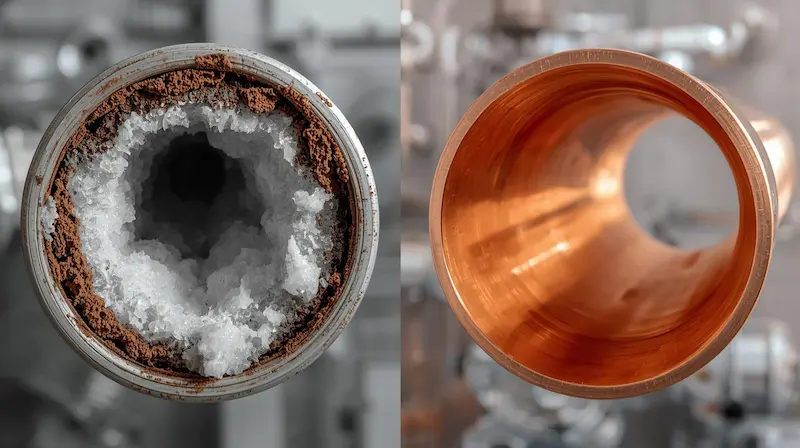
The “Scale” Effect: When hard water hits those super-heated, narrow tubes, the calcium turns into Scale (that white, chalky stuff).
-
The Coating: Scale coats the inside of the tubes like plaque in an artery.
-
The Overheat: The coating acts as insulation. The burner has to work harder and get hotter to transfer heat through the scale to the water.
-
The Failure: Eventually, the heat exchanger overheats, cracks, or sensors trip the system to shut down to prevent an explosion.
How to Know if You Have Hard Water
You don’t need a PhD in chemistry. You just need to look around your house.
The “Eye Test” Signs:
-
Shower Doors: Do you see white, cloudy spots on your glass shower doors that are impossible to scrub off?
-
Faucets: Is there crusty white buildup around the tip of your kitchen faucet or showerhead?
-
Dishwasher: Do your glasses come out looking foggy instead of clear?
-
Dry Skin: Does your skin feel itchy or “squeaky” after a shower?
The Scientific Test: If you want to be sure, buy a Water Hardness Test Strip kit online (they cost about $10). You dip it in your water, and it changes color.
-
0-3 Grains Per Gallon (gpg): Soft. You are safe.
-
3-7 gpg: Moderately Hard. Maintenance required.
-
7+ gpg: Hard / Very Hard. Protection is mandatory.
Fact Check: According to the U.S. Geological Survey, 85% of American homes have hard water. Unless you live in specific parts of the Northeast or Pacific Northwest, assume you have it.
The Solution: 3 Ways to Protect Your Investment
So, do you need a $2,000 whole-house water softener? Maybe. But you have options.
Option 1: The Whole-House Water Softener (The Gold Standard)
This system physically removes the calcium and magnesium from your water and replaces it with sodium (salt).
-
Pros: Protects everything—your tankless heater, your dishwasher, your coffee maker, and your skin.
-
Cons: Expensive ($1,000 – $3,000 installed) and requires you to buy heavy bags of salt monthly.
-
Verdict: If your hardness is over 10 gpg, you need this.
Option 2: The Scale Inhibitor System (The Cheaper Alternative)
These are smaller cartridges installed on the cold water line just before it enters the tankless unit. They use a media (often citrus-based or polyphosphate) that doesn’t remove the minerals but prevents them from sticking to the pipes.
-
Pros: Much cheaper ($150 – $300), compact, no salt needed.
-
Cons: Only protects the water heater, not the rest of the house.
-
Verdict: Perfect for homes with moderate hardness (4-9 gpg) or tight budgets.
Option 3: Aggressive Maintenance (The DIY Method)
If you refuse to install a softener, you must flush your unit.
-
What is it? Once a year, you hook up a small sump pump to your tankless heater and circulate pure distilled white vinegar through it for 45 minutes. The acid eats the scale.
-
The Risk: If you forget to do this for 2 years in a hard water area, the damage might already be irreversible.
-
Verdict: Only for the disciplined DIYer.
Conclusion: Don’t Gamble with Warranty
Here is the kicker: Read the instruction manual of your Rinnai, Navien, or Rheem unit.
Almost all manufacturers state that damages caused by scale buildup are NOT covered by warranty. If your heat exchanger cracks in Year 3 and they find it full of calcium, you are buying a new unit out of pocket.
The Final Answer: If you have hard water (7+ gpg), yes, you absolutely need a treatment system. Whether you choose a full softener or a dedicated scale shield is up to you, but running “naked” water through a tankless heater is a gamble you will eventually lose.
Protect your pipes, and keep that endless hot water flowing.