You have your cordless drill. You bought the Miter Saw we recommended for chopping boards to length. You are officially a DIYer.
But then you look at a project plan—maybe a bookshelf or a cabinet—and it asks you to cut a 4×8 sheet of plywood down to size. Or it asks you to “rip” a 6-inch wide board down to 4 inches.
Your miter saw can’t do that. It only cuts across the board.
To cut along the board (rip cuts) or cut big sheets, you need a new tool. And you are likely staring at two options:
-
The Table Saw: A big, stationary machine.
-
The Circular Saw: A handheld, portable tool.
Which one should you buy?
The answer depends entirely on what you plan to build. In this guide, we’ll break down the Table Saw vs. Circular Saw debate so you spend your money on the tool that matches your projects.
The Circular Saw: The “Go-Anywhere” Workhorse
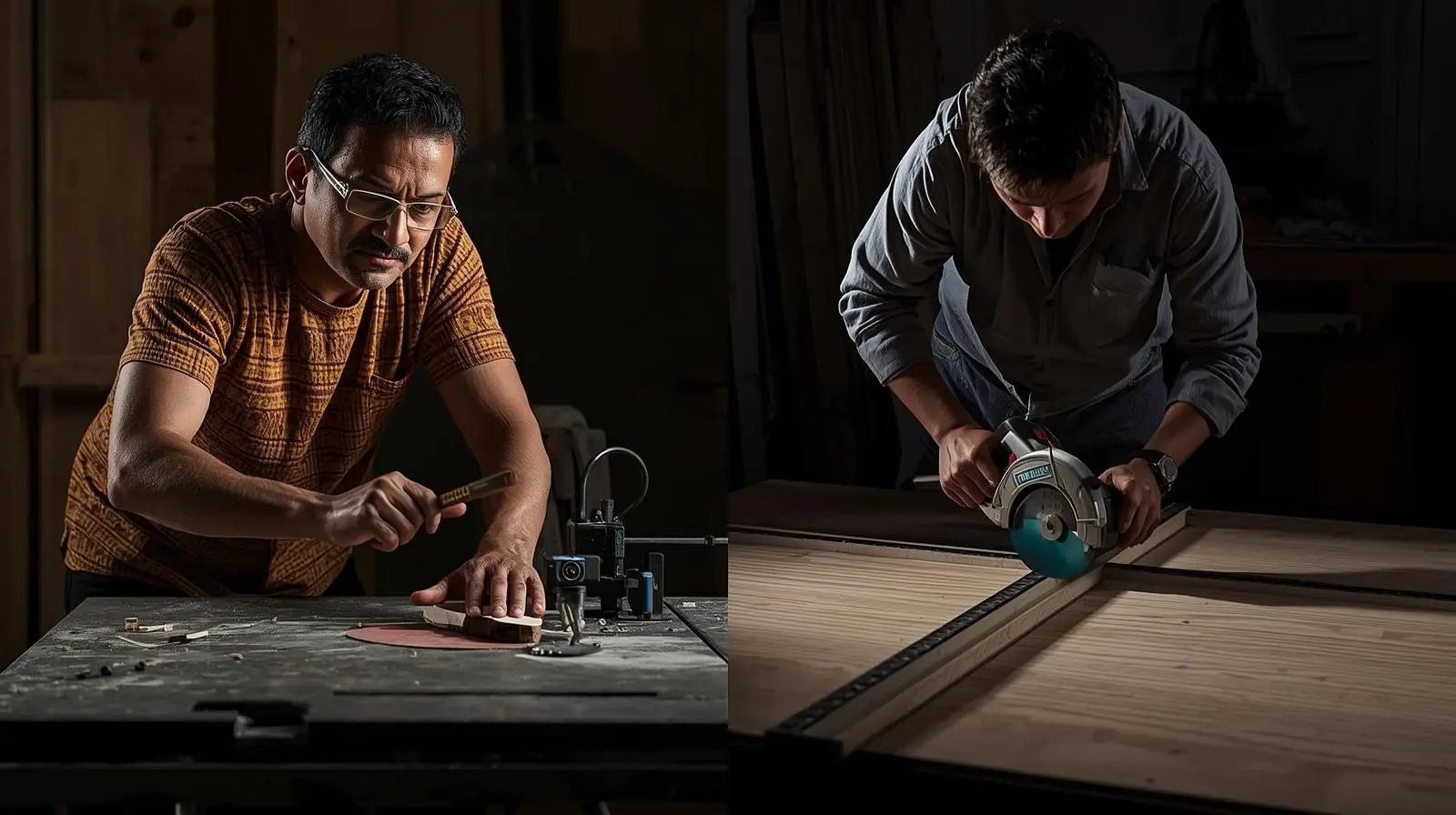
Think of the circular saw as the “construction site” tool. You bring the tool to the wood.
The Pros:
-
Price: Cheap. You can get a solid corded one for $50-$80.
-
Portability: You can take it to the backyard to build a deck or cut plywood in the driveway.
-
Capacity: It can cut huge sheets of plywood that would be dangerous to balance on a small table saw.
The Cons:
-
Accuracy: It’s hard to cut a perfectly straight line freehand. You usually need a “straight edge” guide.
-
Finish: The cut edge is usually rougher.
Best For:
-
Breaking down plywood sheets.
-
Framing a wall or building a deck.
-
Rough carpentry.
The Table Saw: The “Woodshop” Centerpiece
Think of the table saw as the “furniture maker” tool. You bring the wood to the tool.
The Pros:
-
Precision: The “fence” locks in place. You can cut 100 boards to exactly 4 inches wide, and they will be identical. This is crucial for furniture.
-
Repeatability: Once it’s set, it’s set.
-
Versatility: With jigs, you can cut joints (tenons) and grooves (dados).
The Cons:
-
Price: Expensive. A decent job-site table saw starts at $300-$400.
-
Space: It takes up floor space in your garage.
-
Safety: It is statistically the most dangerous tool in the shop. You must respect it.
Best For:
-
“Ripping” solid wood boards.
-
Making cabinets, bookshelves, and furniture.
-
Precision joinery.
The Decision: Which One First?
Here is my rule of thumb for beginners:
Scenario A: The “Home Improver”
If you are building a deck, a fence, or fixing things around the house:
-
Buy a CIRCULAR SAW first.
-
It’s cheaper, safer, and better suited for big, heavy lumber.
Scenario B: The “Furniture Builder”
If you want to build end tables, cabinets, or picture frames:
-
Buy a TABLE SAW first.
-
You simply cannot build square, precise furniture without one. A circular saw isn’t accurate enough for fine joinery.
The “Cheat Code” for Circular Saws
If you can’t afford a table saw yet but need straight cuts, there is a hack.
Buy (or make) a Track Saw Guide for your circular saw. It clamps to the wood and guides your saw in a perfectly straight line. It turns your $60 circular saw into a precision cutting machine for plywood.
Conclusion: You’ll Probably Own Both
Eventually, most serious DIYers own both. You use the Circular Saw to break down the big heavy sheet of plywood in the driveway, and then you bring the smaller pieces to the Table Saw to cut them to final, perfect dimensions.
But start with the one that fits your current project.
Safety Note: Whichever you choose, these tools spin blades at 4,000 RPM. Always wear eye protection. And if you are working with rough lumber, you’ll need to sand those edges smooth. Make sure you have one of the Best Random Orbital Sanders to finish the job right.
Be safe and measure twice!