The lights go out. The refrigerator hum stops. The Wi-Fi disconnects.
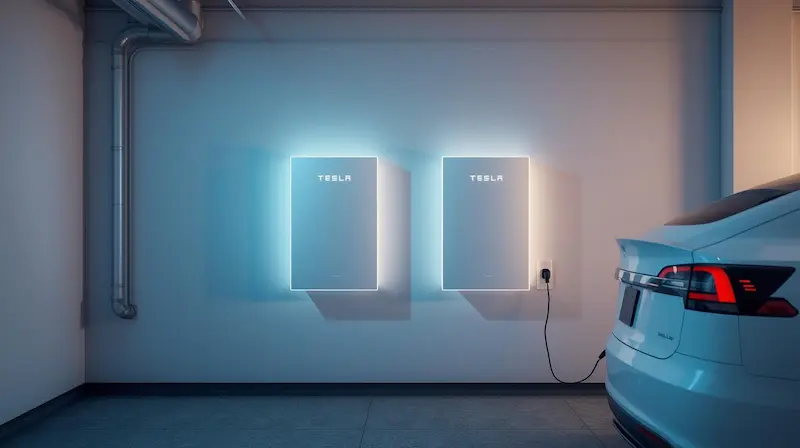
Outside, the entire neighborhood is pitch black. But in your house, the lights flicker for a millisecond and then come right back on. You keep watching Netflix. Your milk stays cold. You are the only house on the block with power.
This is the dream that sells Solar Batteries.
For years, batteries like the Tesla Powerwall were seen as luxury toys for tech enthusiasts or survivalists preparing for the apocalypse. They were expensive, bulky, and didn’t offer much Return on Investment (ROI).
But in 2026, the equation has changed. Utility companies have changed the rules (looking at you, NEM 3.0), and grid instability is a real concern for millions of homeowners.
If you are considering going solar—maybe you are even looking at those sleek [Solar Roof Shingles] we reviewed—you are likely asking: “Do I need to spend another $15,000 on batteries?”
In this guide, we will move past the “cool factor” and look at the cold, hard math. We will analyze the real costs, the new financial incentives, and help you decide if a home battery is a smart investment or just an expensive generator.
What Does a Solar Battery Actually Do?
Many people misunderstand solar panels. They assume that if the grid goes down, their panels will keep working.
False. For safety reasons, standard solar inverters shut down during a blackout. If the grid dies, your panels die. You have zero power, even on a sunny day.
A Solar Battery changes this. It stores the excess energy your panels generate during the day so you can:
-
Use it at night (Self-consumption).
-
Use it during a blackout (Backup power).
-
Sell it back to the grid when prices are high (Arbitrage).
The Cost: The Elephant in the Garage
Let’s get the scary part out of the way. Batteries are not cheap.
-
Average Cost (Installed): $12,000 – $18,000 for a single battery system (like a Tesla Powerwall 3 or Enphase IQ 5P).
-
Federal Tax Credit: The good news is the 30% Solar Investment Tax Credit (ITC) applies to battery storage, even if you install it later. That knocks about $4,000 off the price.
-
Net Cost: Approx. $10,000 – $12,000.
Note: One battery usually isn’t enough to run a whole house (AC, Electric Stove, etc.). It’s enough for “Critical Loads” (Lights, Fridge, Wi-Fi). Whole-home backup often requires 2-3 batteries, doubling the cost.
Reason 1: Energy Independence (The Emotional Value)
This is why most people buy them. Peace of mind.
If you live in an area with frequent storms, hurricanes, or rolling blackouts (hello, Texas and California), a battery is an insurance policy.
-
Vs. Generators: A gas generator is cheaper ($5,000 installed) but requires maintenance, fuel, and is incredibly loud. A battery is silent, automatic, and refuels itself from the sun.
Is it worth it? Financially? Probably not. You can buy a lot of thrown-out milk for $12,000. But for the comfort of knowing your family is safe and powered during a storm? Priceless.
Reason 2: Time-of-Use & NEM 3.0 (The Financial Value)
This is the big shift in 2026.
In the past, utility companies offered “Net Metering.” They paid you full retail price for the solar power you sent to the grid. You used the grid as a free “virtual battery.”
Those days are gone. Under new rules (like NEM 3.0 in California), utilities now pay you pennies for your solar power during the day, but charge you dollars to buy power at night.
How a Battery Saves You Money:
-
Store, Don’t Sell: Instead of selling your excess solar power for $0.05/kWh at noon, you store it in the battery.
-
Use, Don’t Buy: At 7:00 PM, when electricity rates skyrocket to $0.50/kWh, your house runs off the battery instead of the grid.
Is it worth it? If your utility has aggressive Time-of-Use (TOU) rates or poor Net Metering buy-back rates, YES. In these scenarios, a solar system without a battery basically loses money. The battery is the only way to make the math work.
The Cons: Why You Might Wait
It’s not all sunshine and roses.
-
Lifespan: Most batteries have a warranty of 10 years. Your solar panels will last 25 years. This means you will likely have to buy a new battery halfway through your system’s life.
-
Capacity Fade: Just like your iPhone, home batteries hold less charge over time. By year 10, it might only hold 70% of its original capacity.
-
Fire Risk: While extremely rare, lithium-ion batteries do carry a slight fire risk, which is why code requires them to be installed in specific locations (usually garages or outside walls), which can complicate installation.
Conclusion: Who Should Buy One?
Let’s simplify the decision.
Buy a Battery IF:
-
You live in California (NEM 3.0) or any state with bad solar buy-back rates. The battery is necessary to save money.
-
You experience frequent blackouts. The value is in the security, not just the dollars.
-
You are tech-forward. You want to maximize your self-consumption and be “off-grid” as much as possible.
Skip the Battery IF:
-
You have 1:1 Net Metering. If your utility company still gives you full credit for your solar power, the battery has almost zero financial ROI. Use the grid as your free battery while you still can.
-
Grid reliability is 100%. If you never lose power, a $12,000 generator is overkill.
Final Thought: Solar batteries are no longer just a luxury; for many, they are the key to unlocking the true savings of solar power. If you are already putting up panels, take a hard look at your utility bill. That white box in the garage might just be the smartest appliance you ever buy.