There is a specific sound that every homeowner knows. It’s the hollow, rattling thwack of a cheap bedroom door slamming shut.
Or worse, it’s the sound of hearing everything happening in the hallway—the TV, the conversation, the washing machine—right through your closed bedroom door.
When we plan a renovation, we obsess over paint colors and flooring types. But we often treat interior doors as an afterthought. We usually just grab the cheapest pre-hung option at the hardware store and move on.
This is a mistake.
The door you choose is the primary barrier between you and the rest of the house. It dictates privacy, noise control, and the “feel” of quality in your home.
If you are currently planning a project—especially something like a [Basement Guest Suite] where privacy is paramount—you are likely facing a choice: Hollow Core vs. Solid Core.
The price difference is significant. But is the performance difference real? In this guide, we will break down the construction, the soundproofing capabilities (STC ratings), and the ROI of upgrading your doors.
The Three Contenders: What Are You Buying?
First, let’s clear up a common misconception. “Solid Core” is not the same as “Solid Wood.”
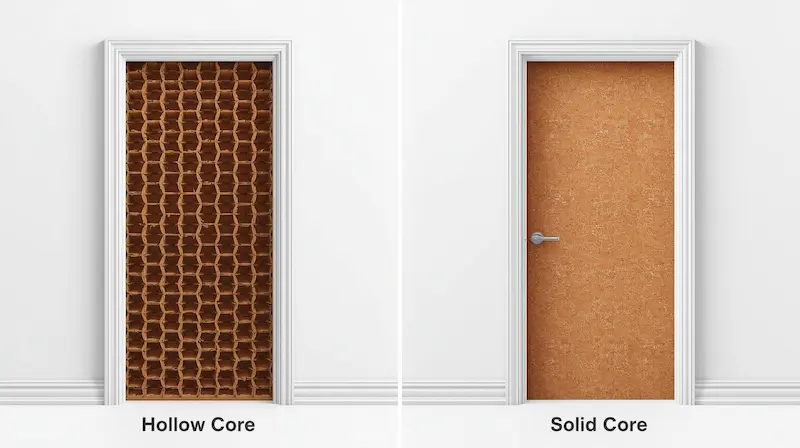
1. Hollow Core (The Standard)
-
Construction: A thin veneer of wood or fiberboard (MDF) glued over a cardboard honeycomb structure. The edges are solid wood, but the center is mostly air.
-
Weight: Very light (20-30 lbs).
-
Cost: $50 – $80 per door slab.
2. Solid Core (The Upgrade)
-
Construction: The same exterior skin as a hollow door, but the inside is filled completely with a heavy engineered wood composite (particleboard or mineral core). It is solid all the way through, but made of synthetic materials.
-
Weight: Heavy (60-80 lbs).
-
Cost: $140 – $250 per door slab.
3. Solid Wood (The Luxury)
-
Construction: 100% natural lumber (Pine, Oak, Maple). No fillers, no glue composites.
-
Weight: Heavy.
-
Cost: $400 – $1,000+ per door.
-
Note: For this article, we are focusing on Solid Core vs. Hollow Core, as Solid Wood is in a completely different price bracket.
Round 1: Soundproofing (The STC Rating)
This is the main reason people upgrade. If you have teenagers, a home office, or a rental suite, you want to block noise.
We measure this using STC (Sound Transmission Class). The higher the number, the better the sound blocking.
-
Hollow Core Door: STC 20-25.
-
Reality: You can hear normal speech through the door easily. It blocks almost nothing.
-
-
Solid Core Door: STC 30-35.
-
Reality: Loud speech becomes muffled/unintelligible. Normal TV volume is significantly dampened.
-
-
Solid Wood Door: STC 28-32.
-
Surprise: Solid Core actually blocks sound better than real wood because the composite density is higher and more uniform.
-
The Verdict: If sound privacy is your goal, Solid Core is the clear winner. It offers the best sound dampening per dollar.
Round 2: Durability and “Feel”
There is a tactile difference between the two.
-
The “Punch” Test: If you stumble and hit a Hollow Core door with your elbow or a moving box, you can punch a hole right through the skin. They are fragile. Solid Core doors are virtually indestructible for normal interior use.
-
The Swing: Solid Core doors have “heft.” They swing shut with a satisfying, heavy thud (like a hotel door) rather than a rattle. This subconsciously makes the entire house feel more expensive and well-built.
The Verdict: For high-traffic areas or kids’ rooms where roughhousing happens, Solid Core is safer and longer-lasting.
Round 3: Installation Difficulty
If you are a DIYer, weight matters.
-
Hollow Core: You can easily carry this under one arm. One person can hang a hollow core door in 20 minutes.
-
Solid Core: These are beasts. You will likely need a helper to hold the door while you screw in the hinges.
-
Hardware Upgrade: Because Solid Core doors are heavy, you generally need three hinges (hollow often use two) and longer screws to anchor the frame into the studs, or the door will sag over time.
Tip: If you are installing new trim or casing around your new heavy doors, make sure your cuts are precise. A quality miter saw is your best friend here. Check out our guide on [The 7 Best Miter Saws for Beginners] if you need to upgrade your tools.
The Decision Matrix: Where to Spend the Money?
Replacing every door in your house with Solid Core is expensive (adding $1,000 – $2,000 to a renovation). You don’t need to do them all. Mix and match to save budget.
Use SOLID CORE For:
-
Bathrooms: Nobody wants to hear what happens in there.
-
Bedrooms: For sleeping privacy and blocking hallway light/noise.
-
Home Office: Essential for Zoom calls.
-
Basement Suites: If you are building a [Basement Guest Suite], Solid Core is non-negotiable. It separates the mechanical noise of the furnace room and provides guests with a hotel-like experience.
Use HOLLOW CORE For:
-
Closets: Pantries, linen closets, and walk-in closets. There is zero need to soundproof your towels.
-
Laundry Rooms: Unless the machine is very loud.
-
Low-Budget Flips: If you are selling the house immediately, the ROI on solid doors might not be there.
Conclusion: A Worthy Upgrade?
Is it worth paying double the price for a Solid Core door?
In my experience, yes.
The door is the one part of the house you touch every single day. The feeling of a solid, heavy door and the quiet it provides is a luxury that you will appreciate constantly. It’s an invisible upgrade that makes a starter home feel like a custom home.
So, for your next bedroom or bathroom project, skip the cardboard door. Spend the extra $80. Your ears (and your teenagers) will thank you.