Hi, I’m Claire. If you’re like me, you look at your unfinished basement and you don’t just see concrete walls and spiderwebs. You see a goldmine.
It’s the largest, completely untapped space in your home. You start dreaming: a private guest suite for the in-laws, a killer short-term rental (hello, Airbnb income), or just a quiet, separate space for your teenager.
The dream is easy. But then comes the big, scary question: What is the real cost to finish a basement to create a guest suite?
If you’ve Googled it, you’ve seen the vague answers: “It depends.” I hate that answer.
I’ve managed projects from a simple drywall job to a full-gut reno, and I can tell you: a basement guest suite is a massive project. It’s building a small apartment inside your house. You’re dealing with plumbing, electrical, and life-safety rules (egress) that you don’t have when painting a bedroom.
So let’s be honest about the numbers. This isn’t a $5,000 weekend project. But it’s also one of the single best investments you can make in your home. We’re going to break down every single line item—the permits, the materials, the labor—so you can build your budget with your eyes wide open.
Part 1: The Sticker Shock & The Silver Lining (Average Cost & ROI)
Let’s not bury the lede. For a professionally finished, code-compliant basement guest suite (approx. 700-1000 sq. ft.) that includes a bedroom, a full bathroom, and a small living/flex space, you should budget:
-
National Average Cost (Pro): $45,000 – $85,000+
-
Average Price Per Square Foot: $50 – $120
Why the huge range? A $45k build might use budget-friendly LVP flooring and a simple bathroom. An $85k build might involve moving plumbing, adding a kitchenette, and high-end finishes.
The Silver Lining: The ROI (Return on Investment)
Here’s why it’s worth it. According to Remodeling Magazine’s “Cost vs. Value” report, a basement finish is consistently one of the best ROIs in home renovation, often recouping 60% – 75% of its cost upon resale.
You’re not just building a suite; you’re adding legal, appraised square footage to your home. That $50,000 project could add $35,000+ to your home’s value instantly, plus you get to use it.
Part 2: The “Non-Negotiable” Foundation Costs (The Hidden Killers)
These are the costs you must pay before you even think about framing a wall. Ignoring these will turn your dream project into a nightmare.
1. Permits: The “Protect Your Investment” Fee
Average Cost: $500 – $2,000 Do not try to do this “off the books.” A permit is your insurance. It ensures a licensed inspector signs off on the electrical, plumbing, and framing. When you sell, you can legally list your home as having an “X-bedroom, X-bath” with a finished basement. An unpermitted build? That’s just “storage space” with illegal plumbing.
2. Egress: The Life-Safety Requirement
Average Cost: $3,000 – $7,000 This is the single most-overlooked, non-negotiable cost. To legally call a basement room a bedroom, it must have an egress (exit) route in case of fire. This means either:
-
A door that leads directly outside.
-
An egress window of a specific minimum size, with a permanently attached ladder if it’s deep.
This involves cutting a massive hole in your foundation, installing the window, and digging a large “window well” outside. It’s a structural job. It’s expensive. And it’s 100% required.
3. Waterproofing: The “Don’t Build on a Puddle” Step
Average Cost: $0 – $10,000+ This is the big variable.
-
Best Case ($0): Your basement is 100% dry and has been for years.
-
Good Case ($1,500): You apply a high-quality waterproof sealant paint to the walls and floors as a precaution.
-
Worst Case ($5,000 – $15,000): You have moisture issues. You now have to pay for a “French drain” (perimeter drain) and a sump pump before you can build.
Claire’s Pro Tip: Do NOT build a $50,000 guest suite on top of a $50 puddle. Test your basement. Tape a 2×2 foot square of plastic sheeting to your floor and walls. Wait 72 hours. If you see condensation under the plastic, you have a moisture problem. Fix it first.
Part 3: The “Big 3” Systems (Plumbing, Electrical, HVAC)
This is where you’re bringing your house’s “guts” down into the concrete box.
1. Plumbing (The Bathroom)
Average Cost: $9,000 – $18,000 This is the single most expensive room in your basement. Why?
-
Breaking Concrete: If your main drain is “above grade” (in the ceiling), you must break up the concrete floor to run pipes for the toilet, shower, and sink.
-
Ejector Pump: More likely, you’ll need an up-flush toilet or a sewage ejector pump ($1,500 – $3,000) to pump waste up to your home’s main sewer line.
-
This cost includes the framing, plumbing rough-in, fixtures (toilet, vanity, shower), and finishes.
2. Electrical
Average Cost: $4,000 – $9,000 Your basement needs everything. This isn’t just hooking up a lamp.
-
New Sub-Panel (Recommended): Your main panel is probably full. A new sub-panel ($800 – $1,500) gives the basement its own dedicated power.
-
Wiring: Running wire for dozens of new outlets (code requires them every 6-12 feet), switches, and ceiling lights.
-
Lighting: Recessed “can” lights are the standard.
-
Safety: You’ll need hard-wired smoke detectors and AFCI/GFCI breakers, which are expensive but required by code.
3. HVAC (Heating & Cooling)
Average Cost: $1,500 – $5,000 How will you heat and cool the space?
-
Cheap Option ($1,500): Tapping into your existing HVAC ducts. This might work, but it can “steal” air from your upstairs and make the whole system less efficient.
-
Good Option ($2,000 – $4,000): Adding a “zoning” system to your existing HVAC.
-
Best Option ($3,000 – $5,000): A Ductless Mini-Split. This is a separate, high-efficiency unit with its own remote. It doesn’t touch your main system and gives your guests (or you) full control.
Part 4: The Build-Out & Finishes (The Fun Stuff)
This is the lumber, drywall, and flooring that turns the “cave” into a “suite.”
1. Framing & Insulation
Average Cost: $3,000 – $7,000
-
Framing: Building the wood or metal stud walls for the bedroom, bathroom, and living area.
-
Insulation: You’ll be insulating all exterior (foundation) walls and the ceiling.
-
Claire’s Pro Tip: Spend the extra $500 on soundproofing insulation (like Rockwool) for the ceiling and interior walls. When someone is walking upstairs, your guests will thank you. When your in-laws are visiting, you will thank you.
2. Drywall
Average Cost: $2,500 – $5,000 This is the “dust storm.” It includes hanging the drywall (Sheetrock), taping, mudding, and sanding it to a smooth, paint-ready finish. Don’t underestimate the skill this takes. A bad mud job will show every seam and screw.
3. Finishes (Flooring, Paint, Doors, Trim)
Average Cost: $6,000 – $15,000+ This is the “how long is a piece of string” category. It’s 100% dependent on your taste.
-
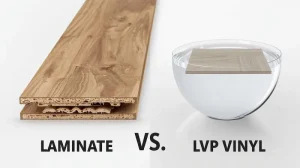
Flooring: Luxury Vinyl Plank (LVP) is the king of basements. It’s 100% waterproof, durable, and looks like real wood. ($3 – $7 per sq. ft. installed). Do not put solid hardwood in a basement.
-
Paint: A 5-gallon bucket of good paint is $200+.
-
Doors & Trim: Solid-core doors (for sound) and MDF baseboards/casing.
Part 5: The Final Tally: DIY vs. General Contractor
So, can you save money by doing it yourself? Absolutely. But “DIY” doesn’t mean “free.” You still have to pay for the egress window, the electrician, the plumber, and all the materials.
Here’s a realistic cost comparison for a 800 sq. ft. guest suite:
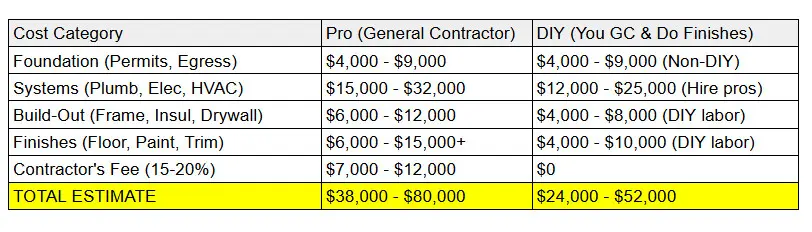
The DIY Savings: You can realistically save $15,000 – $30,000 by acting as your own General Contractor (GC)—hiring the plumber/electrician yourself—and doing the labor for framing, painting, and flooring.
FAQ: What About a Kitchenette?
Average Cost: $5,000 – $12,000 Adding a small kitchenette (a sink, a mini-fridge, a microwave, and some cabinets) is a huge upgrade. The Legal Hurdle: The second you add a stove (or 220v outlet for one), your town will likely re-classify your “guest suite” as a “Accessory Dwelling Unit” (ADU). This triggers a whole new, much stricter set of permit, fire code (like 1-hour fire separation), and zoning rules. Check your local laws first!
Final Thoughts
Yes, the cost to finish a basement to create a guest suite is a big, serious number. It’s one of the largest renovation projects you can take on.
But unlike a kitchen remodel (where you just get a nicer kitchen), a basement project creates new square footage. You are adding a bedroom, a bathroom, and a living space that simply did not exist before.
It’s a huge undertaking, but it’s an even bigger investment. Plan for the non-negotiables (egress, waterproofing), be realistic about your DIY skills, and get ready to unlock the most valuable space in your entire home.
Good luck!