Flooring used to be simple. You either bought real hardwood (expensive), tile (cold), or carpet (hard to clean).
Then came the imitators.
For years, Laminate was the king of “fake wood.” It was cheap, click-lock, and looked okay. But recently, a new challenger has taken over the aisle at Home Depot: LVP (Luxury Vinyl Plank).
If you are walking through the flooring section today, they look almost identical. Both look like wood. Both click together. Both are affordable.
But if you are planning a renovation—especially a [Basement Guest Suite] or a kitchen update—choosing the wrong one can be a disaster. One of these floors survives floods; the other gets ruined by a leaking dishwasher. One is quiet; the other goes clack-clack-clack when the dog walks on it.
In this guide, we are entering the ring for the ultimate showdown: LVP vs. Laminate. We’ll break down the pros, cons, and why one of them is the clear winner for 2026.
The Contenders: What Are They Made Of?
1. Laminate Flooring
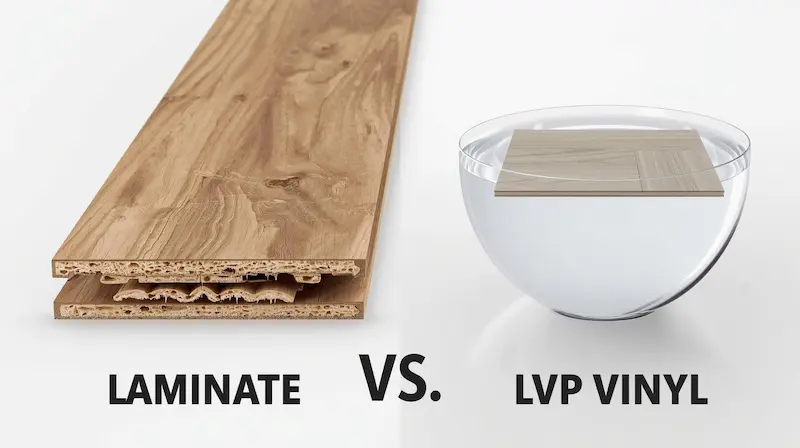
Think of Laminate as “Photo on Wood.”
-
Core: It is made of High-Density Fiberboard (HDF)—basically compressed wood dust and glue.
-
Top: A photographic image of wood glued to the top, covered by a hard clear plastic wear layer.
-
The Weakness: Because the core is made of wood fibers, it acts like a sponge. If water gets in the seams, it swells and bubbles.
2. LVP (Luxury Vinyl Plank)
Think of LVP as “Photo on Plastic.”
-
Core: It is made of PVC (plastic) or a Stone Polymer Composite (SPC).
-
Top: A textured vinyl layer that mimics wood.
-
The Superpower: It is 100% waterproof. You could throw a plank in a swimming pool for a week, take it out, and reinstall it.
Round 1: Waterproofing (The Dealbreaker)
This is usually where the decision is made.
-
Laminate: Most modern laminates claim to be “water-resistant” (up to 24 hours). But if a pipe bursts or your basement floods, the floor is trash. It cannot be salvaged.
-
LVP: It is impervious to water.
-
Verdict: If you are flooring a Basement, Bathroom, Kitchen, or Laundry Room, LVP is the only choice. Do not put laminate in a basement (concrete floors release moisture that will warp laminate from the bottom up).
Round 2: Durability & Pets
Do you have a 80lb Golden Retriever?
-
Scratch Resistance: Laminate actually wins here. The hard plastic coating on laminate is incredibly tough against dog claws and furniture drags. LVP is softer; heavy furniture can dent it, and sharp claws can leave microscopic scratches over time.
-
Traction: Laminate can be slippery. LVP usually has a bit more texture and grip.
-
Verdict: Tie. Laminate is harder to scratch, but LVP is quieter and easier for dogs to walk on.
Round 3: Look and Feel
-
Laminate: It tends to sound “hollow” when you walk on it. It feels rigid. Visually, high-end laminate can look slightly more realistic than cheap vinyl.
-
LVP: It feels “dead” and solid underfoot (quieter). It is softer to walk on. However, cheap LVP can look like… well, plastic. You need to buy mid-range or higher to get a realistic matte finish.
-
Verdict: LVP wins on comfort/sound; Laminate wins slightly on visuals (at the high end).
Round 4: Installation & Cost
-
Installation: Both are “Floating Floors” (click-lock). Both are easy DIY projects. However, cutting LVP is easier—you can score and snap it with a utility knife (no dust!). Laminate requires a saw (lots of sawdust).
-
Cost:
-
Laminate: $1.00 – $3.50 sq. ft.
-
LVP: $2.50 – $5.00+ sq. ft.
-
-
Verdict: Laminate is generally cheaper, but LVP is easier to install without power tools.
Conclusion: The Winner Is…
For 90% of modern homes, LVP (Luxury Vinyl Plank) is the winner.
The fact that it is 100% waterproof makes it “life-proof.” You don’t have to worry about the kids spilling juice or the basement having a humid day. The slight price premium is worth the peace of mind.
Pro Tip: If you decide on LVP, look for “SPC Core” (Stone Polymer Composite). It is rigid, dense, and feels the most like real hardwood.
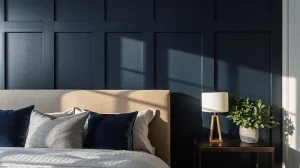
Now that you have your floor picked out, what about the walls? A new floor deserves a new backdrop. Check out our tutorial on creating a [DIY Board and Batten Accent Wall] to finish the room with style.