Let’s be honest: Nobody likes sanding.
It is the vegetables of the DIY world. It’s dusty, it’s noisy, it makes your hand numb, and it feels like it takes forever. But it is also the single most important step in any project.
If you skip sanding, your stain will be blotchy. If you rush it, your paint will peel. Whether you are prepping for our [DIY Cabinet Painting Guide] or refinishing a tabletop, the difference between a “Pinterest Fail” and a professional result is usually 120-grit sandpaper.
The good news? If you hate sanding, you are probably using the wrong tool.
Old-school “sheet sanders” (the square ones that vibrate) are slow and leave scratch marks. Belt sanders are aggressive beasts that can ruin a piece of furniture in seconds.
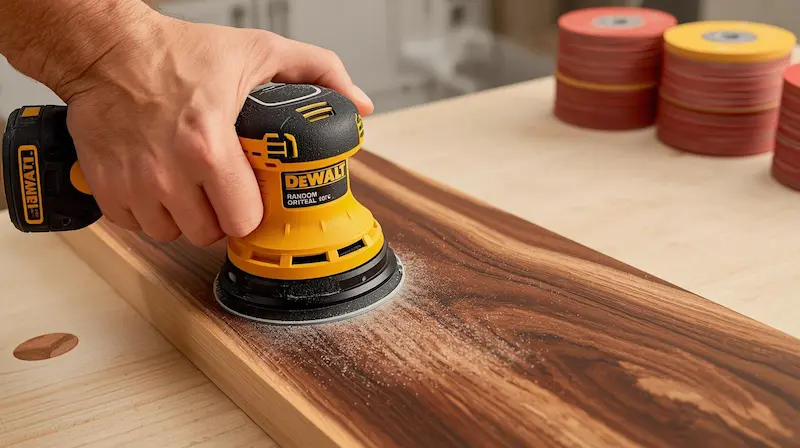
The Goldilocks solution is the Random Orbital Sander (ROS). It spins and vibrates simultaneously in a random pattern, meaning it removes material fast but leaves zero swirl marks.
In this guide, we are going to look at the best random orbital sanders for DIYers in 2026. We will compare the stalwarts (DeWalt, Bosch) against the budget options to save your wallet—and your wrists.
What to Look For (The Buying Criteria)
Before you buy, here are the three features that actually matter.
1. Vibration Control
This is #1. Cheap sanders vibrate your entire arm. After 20 minutes, your hand will feel like it’s buzzing for hours. Good sanders isolate the vibration so only the sanding pad moves, not the handle.
2. Dust Collection
Sanding creates fine dust that gets everywhere (and is bad for your lungs).
-
The Bag: Most come with a little cloth bag. They are okay-ish.
-
The Port: Look for a sander with a round dust port that hooks up to your Shop-Vac. This is the pro secret. It removes 90% of the dust instantly.
3. Corded vs. Cordless
-
Corded: Unless you are working on a ladder or a roof, buy corded. Sanding takes time. Batteries die in 20 minutes of continuous sanding. A corded sander runs at 100% power forever and is lighter.
-
Cordless: Great for quick touch-ups or outdoor projects where finding an outlet is a pain.
The Top Picks for 2026
1. The Best All-Rounder
Model: DeWalt DWE6423K (5-Inch Corded)
This is the sander you will find in most pro woodshops and serious DIY garages.
-
Why it wins: It is short. The low profile gets your hand closer to the work surface, giving you better control. The vibration is minimal. It just works, day in and day out.
-
The Cons: The dust bag is tricky to twist on and off.
-
Price: ~$80.
2. The Dust Collection King
Model: Bosch ROS20VSC
Bosch is famous for its filtration.
-
Why it wins: The canister filter on the back actually captures fine dust (unlike the cheap cloth bags on other brands). If you don’t own a Shop-Vac, this is the sander to buy. It also has a buttery smooth variable speed trigger.
-
The Cons: Slightly taller/bulkier than the DeWalt.
-
Price: ~$70.
3. The Budget Pick
Model: Ryobi ONE+ 18V Random Orbit Sander
If you are already on the Ryobi battery platform (green tools), this is a decent add-on.
-
Why it wins: Convenience. No cords to drag across your workpiece. It’s cheap (tool only).
-
The Cons: It eats batteries. You need a big 4Ah battery to get decent runtime, which makes the tool heavy and top-heavy.
-
Price: ~$50 (Tool Only).
4. The “Money is No Object” Pick
Model: Festool ETS 125
I’m including this just so you know what the pros use.
-
Why it wins: It is an engineering marvel. Zero vibration. When hooked to a vacuum, there is literally no dust. It leaves a finish like glass.
-
The Cons: It costs over $200, and the sandpaper is proprietary (expensive).
-
Price: ~$250+.
Sanding 101: The Grit Progression
Buying the best sander won’t help if you use the sandpaper wrong.
The rule is: Never skip a grit.
-
80 Grit (Coarse): Use this to strip old paint or level out rough wood. It leaves deep scratches.
-
120 Grit (Medium): Removes the scratches from the 80 grit.
-
180/220 Grit (Fine): Removes the scratches from the 120 grit. This is your final stage before staining or painting.
Mistake to Avoid: If you jump from 80 straight to 220, you will leave deep scratches that the fine paper can’t remove. You have to work your way up.
Conclusion: Save Your Wrists
If you are still sanding by hand with a block of wood wrapped in paper, stop.
For under $80, a quality Random Orbital Sander is the best investment you can make for your finish quality. It turns a 4-hour miserable chore into a 30-minute satisfying job.
Ready to start your next project? Now that you have the right sander, you are ready to tackle the big jobs. Why not start by restoring your outdoor space? Check out our guide on [How to Clean and Maintain Composite Decking] (yes, sometimes even composite needs a little love, though thankfully no sanding!).
Go make some sawdust!